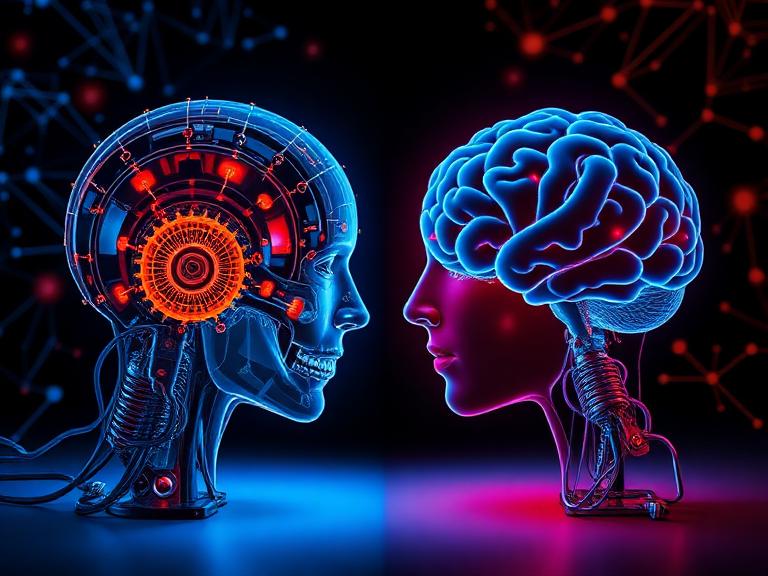
Artificial intelligence has become a part of everyday life. From chatbots and voice assistants to recommendation systems and self-driving technology, AI can now perform tasks that once seemed possible only for humans. This naturally raises an interesting question: How is AI different from the human brain?
At first glance, the comparison seems obvious. AI can process huge amounts of information, recognize patterns, generate text and images, solve complex problems, and work continuously without getting tired. The human brain, on the other hand, is slower at some tasks but can understand emotions, learn from relatively little experience, make judgments in unfamiliar situations, and create ideas based on personal experiences.
So, is AI actually becoming like the human brain?
Not quite.
Although modern AI can imitate certain aspects of human intelligence, the way it works is fundamentally different from how our brains think and learn. Understanding these differences can help us see both the incredible potential of AI and the unique abilities that make human intelligence so special.
What Is Artificial Intelligence?
Artificial intelligence, commonly called AI, refers to computer systems designed to perform tasks that typically require human-like intelligence.
These tasks can include recognizing speech, understanding language, analyzing images, finding patterns, making predictions, and generating content.
Modern AI systems are generally trained using large amounts of data. During training, an AI model identifies patterns in that data and learns how to produce useful outputs based on what it has learned.
For example, an AI writing tool can study patterns across enormous amounts of text and then generate an answer when someone asks a question. An image recognition system can analyze thousands or millions of images to learn what different objects look like.
However, AI doesn’t “think” in exactly the same way a person does. It doesn’t have a human childhood, personal memories, feelings, or a biological understanding of the world.
That’s where the biggest differences begin.
What Is the Human Brain?
The human brain is a biological organ made up of billions of neurons connected through an incredibly complex network.
These neurons communicate using electrical and chemical signals. Together, they allow us to perform an enormous range of activities, including thinking, remembering, learning, feeling emotions, solving problems, imagining possibilities, and making decisions.
One fascinating feature of the human brain is its ability to learn from surprisingly little information.
A child doesn’t need to see thousands of examples of a bicycle to understand what a bicycle is. After seeing a few bicycles, hearing the word, and interacting with the world, the child can usually recognize one in a completely different setting.
Human learning also involves experiences, emotions, senses, social interactions, and consequences.
AI learning works very differently.
AI vs Human Brain: The Biggest Differences
The differences between AI and the human brain go much deeper than simply “computer versus biology.”
Let’s look at the most important ones.
1. How They Learn
One of the clearest differences between AI and the human brain is learning.
AI systems often require large datasets to become highly capable at a specific task. During training, algorithms adjust internal parameters based on patterns found in the data.
For example, an AI system designed to recognize cats may be trained on a huge collection of images containing cats and other objects.
Humans can often learn concepts from only a handful of examples.
A child might see several different dogs and quickly understand that dogs can have different sizes, colors, and shapes while still belonging to the same general category.
Human learning is also continuous. We learn from conversations, mistakes, observation, physical experiences, and social interactions.
AI, meanwhile, generally depends on the design of its training process and the information available to it.
2. Speed and Processing Power
This is an area where AI has a major advantage.
Computers can process enormous amounts of information extremely quickly. An AI system can analyze huge datasets in a fraction of the time it would take a person.
For certain mathematical, computational, or pattern-recognition tasks, machines can outperform humans by an enormous margin.
The human brain is comparatively slow when performing many repetitive calculations.
But speed isn’t everything.
Humans don’t need to process every possible piece of information before making a useful decision. Our brains use experience, intuition, context, and shortcuts to navigate complicated situations.
In everyday life, this ability can be incredibly valuable.
3. Memory
AI and humans also have very different forms of memory.
Computers can store enormous quantities of digital information. Data can be copied, retrieved, and processed without the biological limitations of human memory.
Human memory is much less precise.
People forget names, dates, conversations, and details. Memories can even change over time.
Yet human memory isn’t simply a storage system.
Our memories are connected to emotions, experiences, relationships, and meaning. A particular smell might remind someone of childhood. A song can bring back a specific moment from years ago.
AI doesn’t experience memories in this personal, emotional way.
4. Creativity
Creativity is one of the most interesting areas in the AI vs human brain debate.
AI can generate stories, music, artwork, videos, designs, and ideas. Modern generative AI can produce impressive results in seconds.
But human creativity comes from a much broader collection of experiences.
People create because they want to express an emotion, solve a personal problem, communicate an idea, challenge an existing belief, or make something meaningful.
A person may write a song after experiencing heartbreak. An inventor might create something because they struggled with a problem in everyday life.
AI can generate creative-looking outputs by identifying and combining patterns learned from its training and instructions. But it doesn’t experience heartbreak, excitement, curiosity, or personal ambition in the human sense.
That’s an important distinction.
5. Emotions and Empathy
Humans experience emotions.
We can feel happiness, sadness, fear, anger, excitement, embarrassment, love, and countless combinations of feelings.
These emotions influence how we communicate and make decisions.
AI can recognize emotional language and respond in ways that appear empathetic. For example, a chatbot may recognize that someone is upset and produce a supportive response.
But producing an empathetic response isn’t the same as actually experiencing empathy.
This distinction matters when discussing whether AI can truly replace human interaction.
Technology can assist communication, but human relationships involve shared experiences, emotional connection, trust, and understanding that go beyond generating appropriate words.
6. Common Sense
Humans develop common sense through years of interacting with the physical and social world.
We understand that a glass can break if dropped. We know that someone standing outside in heavy rain might get wet. We recognize sarcasm, social expectations, and subtle context in ways that often happen automatically.
AI can learn many of these patterns from data, but it doesn’t experience the physical world in the same way humans do.
This is one reason AI can sometimes produce an answer that sounds convincing but doesn’t make practical sense.
7. Energy Efficiency
The human brain is remarkably energy efficient.
Although the brain performs an enormous number of processes every moment, it operates using roughly the energy of a small light bulb.
Large AI systems can require significant computing resources for training and operation. Data centers may use substantial amounts of electricity and cooling infrastructure.
This doesn’t mean AI can’t become more efficient. In fact, AI hardware and software are continuously improving.
Still, the human brain remains an extraordinary example of biological computing efficiency.
Can AI Think Like a Human?
This is where things become complicated.
AI can perform tasks that look remarkably similar to human thinking. It can answer questions, summarize information, write stories, analyze patterns, solve problems, and hold conversations.
However, performing an intelligent task doesn’t necessarily mean that AI understands the world exactly as humans do.
Imagine two people solving the same puzzle. One understands the meaning behind the puzzle, while the other follows extremely sophisticated patterns that lead to the correct answer.
The result may look similar, but the process can be very different.
That’s why researchers continue to debate what exactly should count as “thinking,” “understanding,” or “intelligence.”
AI vs Human Brain: A Simple Comparison
| Feature | AI | Human Brain |
|---|---|---|
| Learning | Usually requires training data | Learns from experience and relatively few examples |
| Processing speed | Extremely fast for many computational tasks | Slower for repetitive computation |
| Memory | Large and highly retrievable digital storage | Limited and influenced by experience |
| Emotions | Can recognize and simulate emotional responses | Experiences emotions |
| Creativity | Generates outputs from learned patterns and prompts | Creates from experiences, ideas, emotions, and imagination |
| Common sense | Improving but can make surprising errors | Developed through real-world experience |
| Energy use | Can require substantial computing resources | Highly energy efficient |
| Adaptability | Depends on model, training, tools, and context | Naturally adapts across many situations |
| Consciousness | No established evidence of human-like consciousness | Associated with human subjective experience |
Which Is Smarter: AI or Humans?
There isn’t a simple winner.
AI is better at certain tasks, while humans are better at others.
For example, AI can examine massive datasets, perform calculations quickly, recognize patterns, and automate repetitive work.
Humans are generally much better at navigating unfamiliar situations, understanding social context, forming relationships, applying broad real-world knowledge, and connecting experiences in meaningful ways.
Rather than thinking of AI and humans as direct competitors, it may be more useful to think about how they can work together.
A doctor can use AI to analyze medical information, but human judgment remains important when communicating with a patient and considering their individual circumstances.
A teacher can use AI to create learning materials, while understanding a student’s emotions and personal challenges still requires a human connection.
A designer can use AI to explore dozens of ideas quickly, then use personal taste and experience to decide which direction actually works.
Will AI Replace the Human Brain?
AI will almost certainly replace or automate some tasks that humans currently perform.
Jobs involving repetitive data processing, routine content generation, basic analysis, and predictable workflows may increasingly involve AI.
But replacing individual tasks isn’t the same as replacing the human brain.
Human intelligence isn’t one single ability. It combines reasoning, emotion, social understanding, creativity, physical interaction, memory, imagination, intuition, and personal experience.
AI may become extremely capable in many of these areas, but that doesn’t automatically mean it will reproduce the full complexity of human intelligence.
The more realistic future is likely to involve humans and AI working together.
AI can handle large amounts of information and repetitive work. Humans can provide judgment, values, creativity, communication, and responsibility.
Why the Difference Matters
Understanding the difference between AI and the human brain is important because it helps us use AI responsibly.
AI can be incredibly useful, but it isn’t automatically correct.
A confident-sounding answer can still contain mistakes. A generated image can look realistic without representing reality. A recommendation can be useful without understanding a person’s full situation.
Humans therefore remain responsible for checking information, making important decisions, and considering the consequences of using AI.
The goal shouldn’t necessarily be to create machines that behave exactly like humans.
Instead, one of the most exciting possibilities is creating technology that complements what humans already do well.
The Future of AI and Human Intelligence
The relationship between AI and human intelligence will probably continue to evolve.
Future AI systems may become better at reasoning, learning from fewer examples, understanding context, working with different types of information, and interacting with the physical world.
At the same time, humans will continue to develop new ways of working with these systems.
The most valuable skill may not be competing against AI, but knowing when and how to use it.
AI can give us speed, scale, and powerful tools. Humans bring experience, curiosity, emotion, judgment, and purpose.
Together, these strengths can accomplish things neither could easily achieve alone.
Frequently Asked Questions
1. What is the main difference between AI and the human brain?
The main difference is how they learn and process information. AI learns through algorithms and training data, while the human brain learns through biological processes, experiences, senses, emotions, and social interaction.
2. Is AI more intelligent than humans?
AI is more capable than humans in certain specialized tasks, such as processing large datasets and performing calculations quickly. However, human intelligence is broader and includes emotional understanding, common sense, social intelligence, creativity, and adaptability.
3. Can AI have emotions like humans?
AI can recognize emotional signals and generate responses that appear emotional or empathetic. However, there is no established evidence that current AI systems experience emotions in the same subjective way humans do.
4. Can AI completely replace the human brain?
AI can automate many individual tasks, but completely replacing the human brain is a much more complicated question. Human intelligence combines many abilities, including emotions, experiences, physical interaction, social understanding, and creativity.
5. Will humans and AI work together in the future?
Very likely. AI can help humans analyze information, automate repetitive work, generate ideas, and solve certain complex problems. Humans can provide judgment, creativity, emotional intelligence, and responsibility. Collaboration between the two could become more important across many industries.
Final Thoughts
The debate over AI vs human brain isn’t really about finding a single winner.
AI is extraordinarily powerful at processing information, identifying patterns, and completing specific tasks at impressive speeds. The human brain, meanwhile, remains remarkable because it can learn from experience, understand emotions, adapt to unfamiliar situations, build relationships, and give meaning to the world around us.
AI may become more capable with every generation, but its progress doesn’t make human intelligence less valuable.
If anything, it makes understanding our own intelligence even more important.
The future isn’t necessarily about AI replacing humans. It may be about humans learning how to use AI wisely while preserving the qualities that make human thinking unique.
And that could be far more exciting than the idea of humans and machines simply competing against each other.