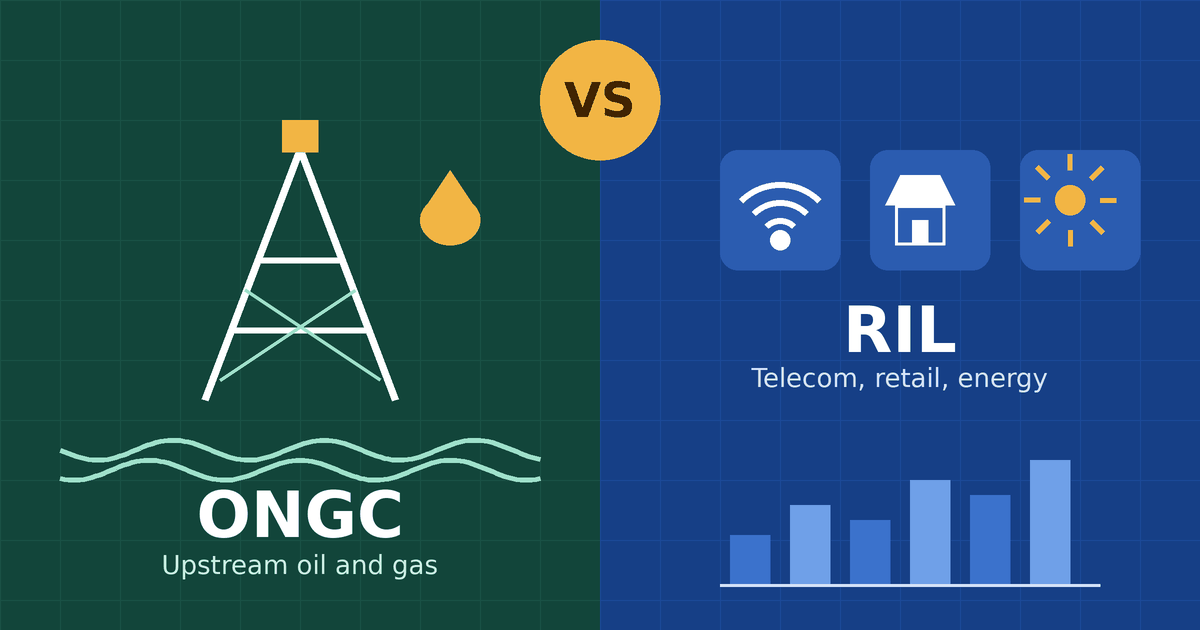
Ask ten Indian investors to name a stable large-cap energy stock and most will say one of two names: Oil and Natural Gas Corporation (ONGC) or Reliance Industries (RIL). Both are heavyweights on the Nifty 50. Both are household names. Yet they behave very differently in a portfolio, and the reasons have little to do with which logo you recognise more.
This guide breaks down what drives each stock, how the two compare, and what you should look at before you check the ONGC share price or the RIL share price and decide to buy.
Two Energy Giants, Two Different Businesses
The first thing to understand is that these companies are not really competitors. They only look similar because both deal with oil and gas.
ONGC is a government-controlled company and India’s largest producer of crude oil and natural gas. Its core business is upstream: finding oil and gas, drilling wells, and selling what comes out of the ground. Its international arm, ONGC Videsh, holds assets in several countries. It also owns a controlling stake in HPCL, which gives it a foothold in refining and fuel retail.
Reliance Industries is a private conglomerate with a much wider reach. Refining and petrochemicals (often called the oil-to-chemicals business) are its traditional base. On top of that sit Jio, one of India’s largest telecom operators, and Reliance Retail, one of the country’s biggest retail chains, plus a growing push into new energy.
In simple terms, ONGC is a bet on the price of oil and gas. Reliance is a bet on India’s consumption story across telecom, retail, and energy.
What Moves the ONGC Share Price
ONGC’s earnings depend heavily on a few variables.
Crude oil prices. When global crude rises, ONGC’s realisations rise, and profits usually follow. When crude falls sharply, earnings come under pressure. Of all the factors, this is the biggest.
Government policy. Because the government is the majority owner, decisions on subsidy sharing, windfall taxes, and gas pricing can affect the bottom line directly. Investors who ignore policy headlines often get surprised.
Production volumes. Ageing fields mean ONGC has to keep investing just to hold output steady. New discoveries and the performance of its offshore projects matter a great deal.
Dividends. ONGC has long been popular with income-focused investors because of its regular dividend payouts. For many shareholders, the dividend yield is part of the reason to hold the stock, so it often influences sentiment.
What Moves the RIL Share Price
Reliance is harder to pin down because several businesses pull in different directions.
Refining margins. The spread between crude costs and the price of refined products affects the oil-to-chemicals segment. Strong margins help; weak ones drag.
Jio and retail growth. Subscriber additions, average revenue per user, store expansion, and festive-season sales all feed into how the market values these arms. Analysts often value them separately from the energy business.
Capital spending. Reliance invests heavily in new ventures, including clean energy. Big spending plans can excite the market or worry it, depending on how convincing the returns look.
Corporate announcements. Reliance’s annual general meeting is closely watched. Announcements about listings, partnerships, or new businesses frequently move the stock.
Comparing the Two: A Quick Look
| Factor | ONGC | RIL |
|---|---|---|
| Ownership | Government-controlled | Promoter-led private company |
| Core business | Oil and gas exploration and production | Energy, telecom, retail, new energy |
| Main price driver | Crude oil and gas prices | Mixed: margins, consumer growth, new ventures |
| Appeal to investors | Dividends, value-oriented | Diversified growth |
| Key risk | Commodity swings, policy interference | Heavy investment cycles, execution risk |
This table is a starting point, not a verdict. Neither stock is better in absolute terms. They suit different goals.
How to Read a Share Price Properly
A common mistake among new investors is to look at a share price and judge the company by whether the number looks high or low. A stock trading at a lower price is not automatically cheaper, and a higher price does not mean the company is overvalued. What matters is how the price compares with earnings, assets, and growth.
When you check the ONGC share price or the RIL share price, look at these alongside it:
- Price-to-earnings (P/E) ratio: how much you pay for each rupee of profit. Compare it with the company’s own history and with its sector.
- Price-to-book (P/B) ratio: especially useful for asset-heavy businesses like ONGC.
- Dividend yield: the annual dividend divided by the share price. Relevant for income investors.
- Debt levels: a company carrying heavy debt is more sensitive to interest rates and slowdowns.
- 52-week range: it shows where the stock sits between its recent high and low, which helps you avoid buying at an emotional peak.
Check the latest figures on a reliable platform instead of relying on old screenshots or forwarded messages. Prices change every trading day.
Which One Fits Your Portfolio?
If you want exposure to oil and gas with a tilt toward dividends, ONGC is a natural candidate. Be ready for volatility whenever crude prices swing.
If you prefer one holding that spreads risk across telecom, retail, and energy, RIL offers that mix. The trade-off is that its performance depends on several businesses all executing well.
Many long-term investors hold both, precisely because they respond to different forces. When crude is strong, ONGC may lead. When consumer spending and digital growth take centre stage, Reliance may do the heavy lifting.
Final Thoughts
Following the ONGC share price and RIL share price teaches you something useful about how Indian markets work: a single sector can contain very different businesses, and understanding what actually drives a company matters more than following its daily ticker.
Do your homework before you invest. Read the latest quarterly results, understand the risks, and match your choice to your time horizon and comfort with volatility.
Disclaimer: This article is for informational purposes only and is not investment advice. Stock market investments are subject to market risks. Please consult a SEBI-registered advisor before making financial decisions.