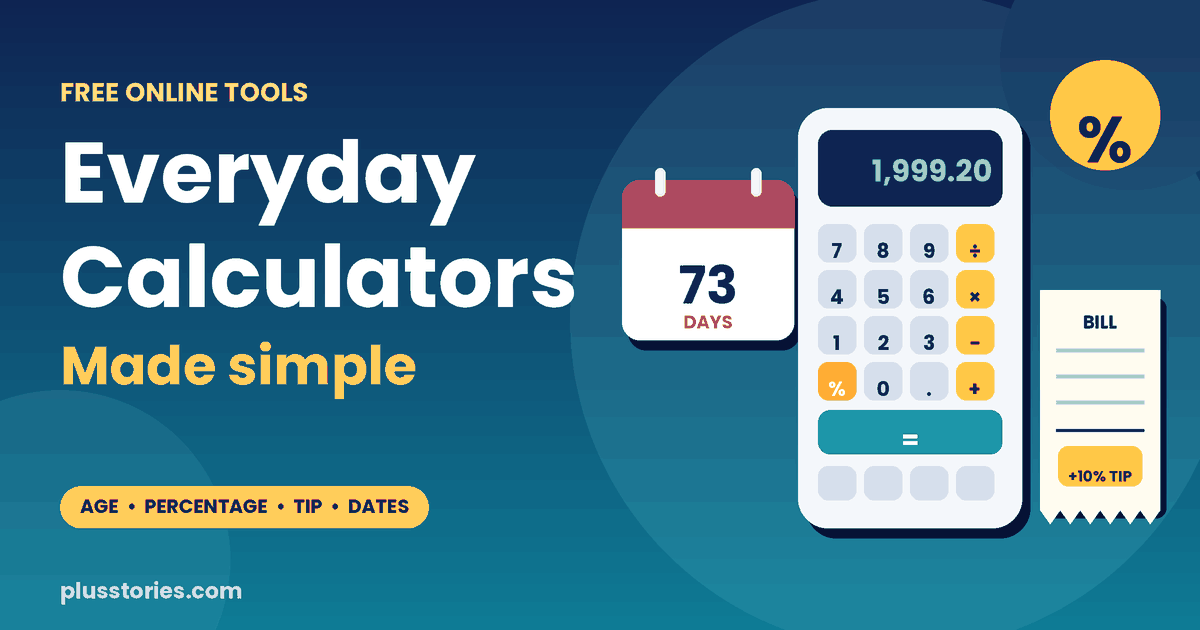
Most of us don’t need a scientific calculator. We need quick answers to small, everyday questions. How old will I be on a certain date? What is 20% off ₹2,499? How many days are left until the exam? What does everyone owe at the restaurant after the tip?
You can do all of this in your head or on paper, but a good free calculator saves time and avoids silly mistakes. This guide explains four of the most useful everyday calculators, how each one works, and when to use it. Each section has a simple worked example, so you can also check the answer yourself.
Why Use an Online Calculator at All?
Mental math is great until the numbers get awkward. A few situations where a calculator wins:
- You are counting days across months with different lengths.
- You need exact years, months and days, not a rough guess.
- You are splitting a bill among friends and want to be fair.
- You are comparing discounts while shopping and need to move fast.
The best tools are the simple ones: free, no sign-up, and quick to use. Some sites run the calculation in your browser, which means you don’t have to hand over personal details just to find out a number. If you are testing a new tool, it’s worth trying an example you already know the answer to first.
1. Age Calculator
What it does: Tells you exact age in years, months and days between a date of birth and any chosen date.
When it helps:
- Checking age eligibility for exams, forms or applications
- Planning milestone birthdays
- Filling in official forms that ask for age “as on” a certain date
Example: Someone born on 15 March 2000, checked on 19 October 2026, is 26 years, 7 months and 4 days old.
If you are checking eligibility for a government exam, always rely on the official notification for the cut-off date, such as the one published on the UPSC website. A calculator is good for a quick check, but the official notice decides.
You can try a simple age calculator on WE Post Today, which is free and doesn’t need an account.
2. Days Between Dates Calculator
What it does: Counts the days between two dates. Some versions also show weeks and weekdays.
When it helps:
- Counting down to exams, trips or deadlines
- Working out notice periods or booking windows
- Tracking how long a habit streak or project has run
Example: From 19 October 2026 to 31 December 2026 is 73 days (not counting the end date). Include the end date and it becomes 74. That small “include end date” option matters more than most people realise, so read it carefully.
Two things to watch for:
- Weekdays vs calendar days: Weekdays are usually Monday to Friday and don’t remove public holidays. For official deadlines, check the holiday list separately.
- Counting rules: Contracts and legal notices sometimes count days in a specific way, so confirm with the document.
A free days between dates calculator handles the counting for you. If you want a second opinion, Time and Date’s duration calculator is another well-known option, and comparing two tools is a good habit when the date really matters.
Countdowns also make festival planning easier. If you are working back from a big day, our Diwali 2026 rangoli designs guide works well alongside a simple date counter.
3. Percentage Calculator
What it does: Works out percentages, discounts, increases and decreases.
When it helps:
- Comparing sale prices
- Working out how much a price has gone up or down
- Calculating marks, margins or savings
Example 1, discount: 20% off ₹2,499 is ₹499.80 off, so you pay ₹1,999.20.
Example 2, increase: If a salary goes from ₹40,000 to ₹46,000, that is a 15% increase (the rise of ₹6,000 divided by the original ₹40,000).
A common mistake: A 20% discount followed by another 10% discount is not 30% off. The second discount applies to the already-reduced price, so the total saving is 28%.
Percentages also show up in bigger decisions, like fees, taxes and loan costs. If you are looking at the money side of life, you might like our guides on hidden costs of buying a home and how to manage cash flow as a freelancer. For GST-related percentages on invoices, the official GST portal is the right place to confirm current rates. A clean percentage calculator is helpful when you just want a quick answer on the spot.
If you want to build a stronger foundation, Khan Academy has free lessons on percentages and ratios.
4. Tip & Bill Split Calculator
What it does: Adds a tip to the bill and divides the total between people.
When it helps:
- Eating out in a group
- Sharing travel costs
- Splitting rent or shared expenses
Example: A bill of ₹1,800 with a 10% tip comes to ₹1,980. Split among 4 people, that is ₹495 each.
Before you tip, check your bill. Many restaurants already add a service charge, so you may not need to add a tip on top. If you go out for a long food walk with friends, a tip and bill split calculator keeps the math fair. It is especially handy after a day of shared plates, like the one in our Chandni Chowk street food guide. You can explore more trip ideas in our Travel section.
Tips for Getting the Most Out of Any Online Calculator
- Test it with a known answer. Try 10% of 100 or a date range you can count by hand.
- Read the options. “Include end date” or “weekdays only” can change the answer.
- Don’t enter sensitive data. You don’t need to share personal or financial details for these simple calculations.
- Double-check big decisions. For loans, taxes, legal deadlines or medical dosing, use official sources or a professional.
- Save time with a bookmark. If you use a calculator weekly, keep it in your browser bookmarks.
Where to Find These Tools in One Place
If you would rather not hunt for a different site every time, WE Post Today keeps a small set of free everyday calculators in one place: age, days between dates, percentage, and tip and bill split. They run in the browser, and no sign-up is required. It is a handy bookmark if you do small calculations often.
FAQs: Free Online Calculators
1. Are free online calculators accurate?
For simple arithmetic like percentages and date gaps, yes. Still test with an example you know, and read the options carefully.
2. Do I need to sign up to use them?
Not for the basic ones. If a simple calculator asks for an account or payment details, think twice.
3. Does the days between dates calculator count public holidays?
Usually not. Most tools count weekdays as Monday to Friday and don’t remove holidays, so check your holiday calendar separately.
4. How do I calculate a percentage discount manually?
Multiply the price by the discount rate, then subtract. For 20% off ₹2,499: 2,499 × 0.20 = ₹499.80, so you pay ₹1,999.20.
5. Is it okay to rely on these tools for official deadlines?
Use them for a quick check, but always confirm the final date or amount from the official notice or document.
Final Thoughts
Small tools make daily life smoother. A quick age check, a discount calculation or a fair bill split takes seconds and removes the arguments and mistakes. Pick a couple of tools you trust, test them once, and keep them bookmarked. You will be surprised how often they come in handy.
General information only. For financial, legal or medical decisions, consult official sources or a qualified professional.