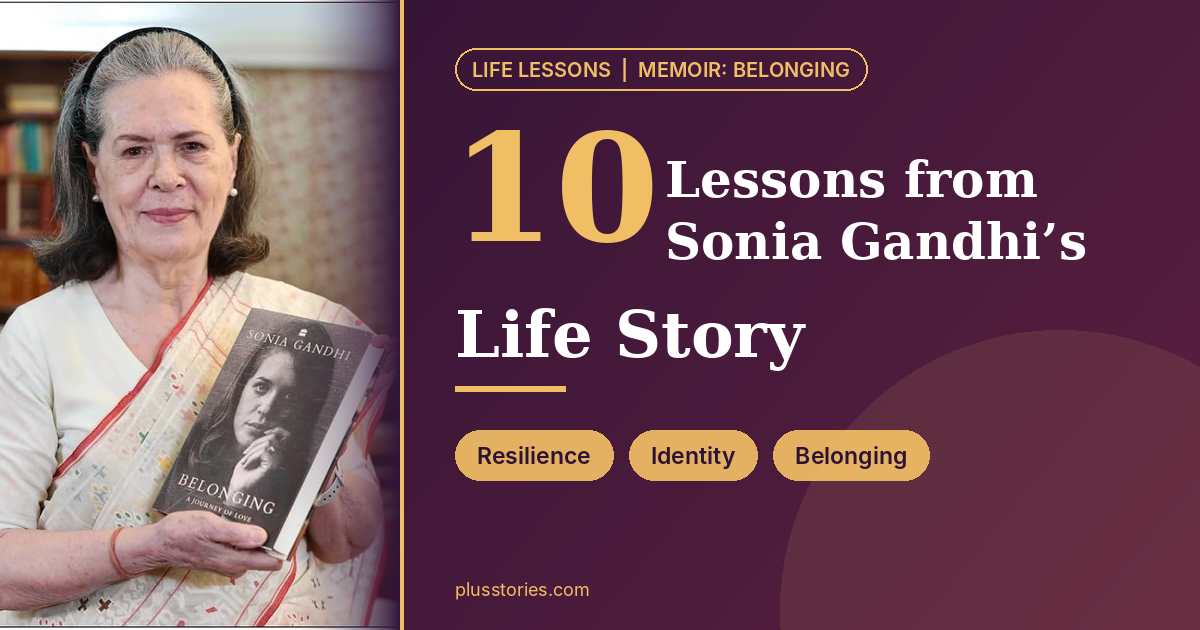
When Sonia Gandhi’s memoir, Belonging: A Journey of Love, came out on 10 November 2026, most of the conversation was about politics. But there is another way to read her story: as a long lesson in how people cope with change, loss and the search for a place to call home.
This piece is not a political analysis, and readers will judge her public life in different ways. It sticks to the personal side, the parts of her story that almost anyone can learn from, whatever their views. If you want the dates and milestones first, start with our Sonia Gandhi journey timeline on Vofeg.
1. Adapt With Curiosity, Not Pressure
She was a 19-year-old student when she met Rajiv Gandhi in Cambridge, and moving to India meant learning almost everything again. According to the publisher’s description of the memoir, she learned to speak Hindi, wear saris and enjoy spicy Indian food.
The lesson is simple. Whether you are moving cities, changing jobs or joining a new family, you do not have to master everything at once. One phrase, one recipe, one custom at a time is how a new place slowly becomes familiar.
2. Let Confidence Grow Slowly
The publisher’s summary describes her gaining confidence by Rajiv’s side rather than overnight. Confidence is often built inside supportive relationships, where you are allowed to be a beginner.
If you are in a new phase of life, look for people who give you room to learn without judging every mistake. That kind of support does more for self-belief than any pep talk.
3. Give Your Grief a Name
The memoir revisits private losses she rarely spoke about in public. As Brut’s overview of the personal chapters explains, one of them is the death of her first child in January 1969, a day after he was born, and the grief and guilt that followed.
Grief and guilt often arrive together, and neither means you did something wrong. Saying a loss out loud, even decades later and at your own pace, can be part of healing. If you are carrying something heavy right now, talking to a trusted person or a counsellor is a strength, not a weakness.
4. Keep Going After Repeated Loss
The memoir covers a series of family tragedies, including the deaths of Sanjay Gandhi and Indira Gandhi, and the 1991 assassination of Rajiv Gandhi, as Eastern Eye’s summary notes.
Resilience, seen through her story, does not mean feeling nothing. It means continuing to show up for the people and responsibilities that still need you, even while you are hurting. Small, steady routines matter most in the hardest seasons.
5. Build an Anchor Before Big Decisions
In an excerpt reported by Siasat, she describes studying the Bhagavad Gita with a teacher from January 1997, using a book from Rajiv’s own shelves, and says it helped her face her fear of entering politics.
You do not need a religious text to borrow the idea. A regular anchor, such as reading, prayer, a daily walk or journaling, gives your mind somewhere steady to stand before you make a major choice.
6. Listen Without Obeying
In the same excerpts she writes about people urging her to take on a political role, and says she would listen quietly but not act on their requests. Years later, Outlook India’s report on the 2004 chapter shows her describing a similar moment of heavy pressure, with a clear decision at the end.
You can respect advice and still make your own call. Hearing someone out is polite. Doing what they say is optional.
7. Choose Duty Over Applause
One analysis of the memoir notes that she refers to Krishna’s teaching on performing your duty without expecting rewards. Whatever your beliefs, the habit is practical: focus on doing the work well, and let recognition be a bonus rather than the goal.
This is a useful mindset for students, parents and professionals alike, especially when effort goes unnoticed for a long time.
8. Protect Your Privacy Without Guilt
She has been known for guarding her privacy for decades, and the memoir touches on her cancer treatment and her wish to keep it private. You decide what to share, when and with whom.
Being private is not the same as being dishonest. In an age of constant sharing, this is a healthy reminder that some experiences can stay yours.
9. Build Belonging, Do Not Wait for It
The book’s own framing, repeated in Khaleej Times’ coverage, is a life shaped by love, duty, loss and the search for a place to belong. Her story began in a small Italian town and unfolded in India, so her identity was never one-sided.
Belonging is rarely handed to you. It is built through people you care for, rituals you adopt and the simple act of showing up again and again. If you feel like an outsider somewhere, take that as the start of the process, not a verdict on you.
10. Tell Your Own Story
She has said that writing about her life did not come easily, because it meant opening up experiences she had kept deep inside, as Business Standard reported.
When other people narrate your life for you, writing it yourself can be a way to take it back. It does not need to be a book. A private journal, a letter to your future self or a few honest pages on a hard year all count.
Quick Takeaways You Can Use This Week
- Learn one small thing about a new environment each day.
- Name a loss or worry to someone you trust.
- Pick one anchor habit, such as ten minutes of reading or a walk.
- Practise listening to advice without feeling forced to follow it.
- Write a few lines about your own story, only for yourself.
Frequently Asked Questions
What is Belonging: A Journey of Love about? It traces Sonia Gandhi’s life from childhood in Italy to her years in India, including her marriage, family losses and entry into public life.
When was the memoir published? On 10 November 2026. The Indian edition from HarperCollins India runs 544 pages.
Is it a political book? She has described it as more personal than political, though it naturally touches on key moments in Indian politics.
Final Thoughts
You can disagree with any public figure and still learn from the human side of their story. The most useful parts of this one are the quiet ones: adapting slowly, grieving honestly, keeping an anchor and building a sense of home. For the full chronology behind these lessons, read our Sonia Gandhi journey timeline, and find more lifestyle reads on Plusstories.