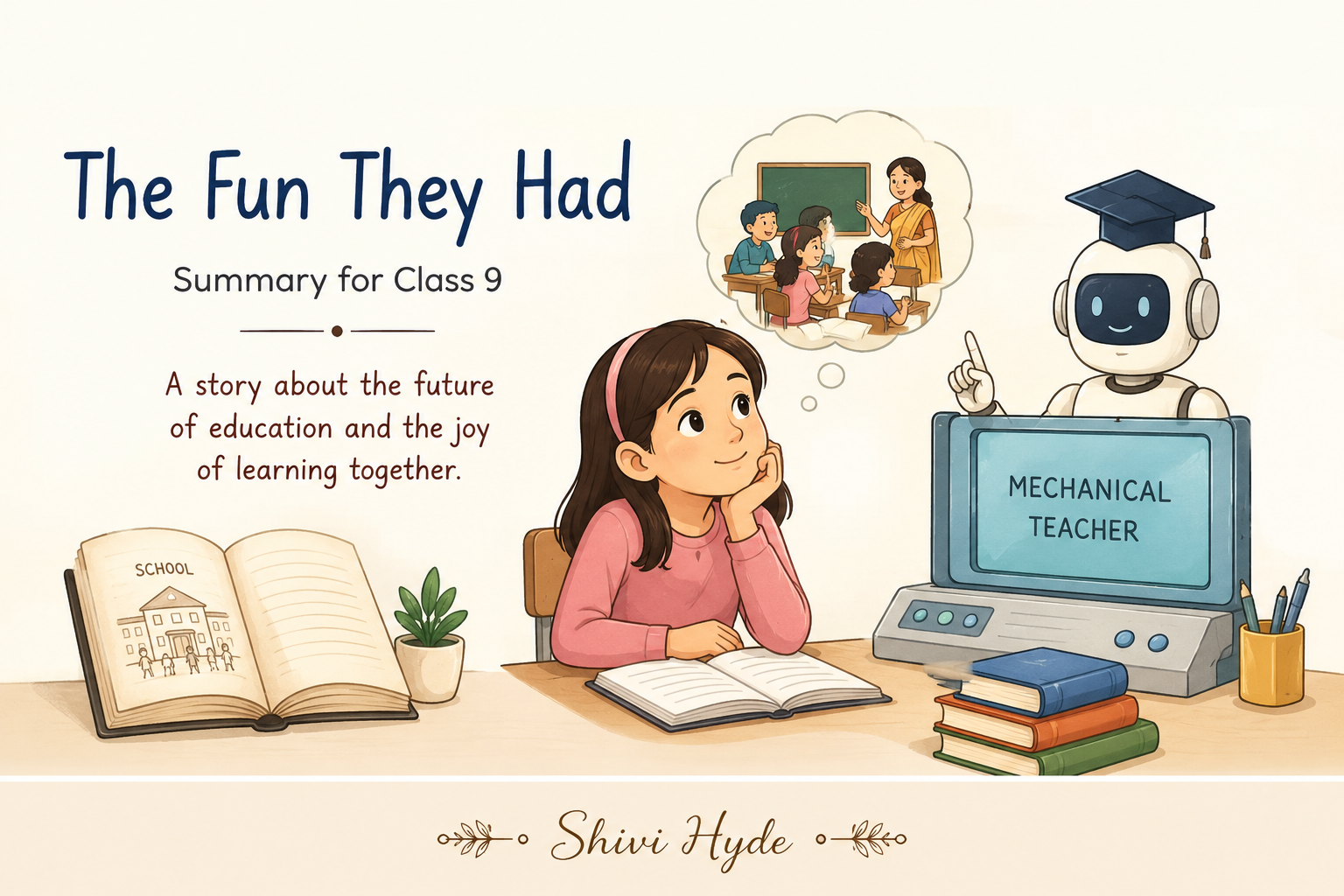
“The Fun They Had” is one of the most thought-provoking chapters in the CBSE Class 9 English syllabus. Written by the celebrated science fiction author Isaac Asimov, this short story takes readers into the year 2157, imagining a future where classrooms, teachers, and books look nothing like what we know today. Through the eyes of two children, Margie and Tommy, Asimov paints a picture of education that is entirely mechanical, isolated, and, in many ways, joyless compared to the schools of the past.
What the Story Is About
The story opens with Margie writing in her diary about an extraordinary discovery: an old, real paper book. This might sound ordinary to us, but for Margie, it is a strange and fascinating object because, in her world, books exist only in digital form on screens. She and every other student in her neighborhood are taught individually at home by mechanical teachers—robotic tutors programmed to give lessons and tests based on each child’s pace of learning.
Margie doesn’t particularly enjoy school. Her mechanical teacher constantly tests her, and she has been struggling with geography lately, especially questions related to how rivers were formed. Her frustration only grows when the County Inspector has to be called in to fix her mechanical teacher after it starts giving her tests that are far too difficult for her level.
It is at this point that Tommy, a slightly older boy, shows Margie the old book he found in his attic—yellowed pages, printed text, and pictures that don’t move like the ones on her screen. Tommy explains that the book describes “old-fashioned” schools, the kind that existed hundreds of years ago, where children of the same age gathered together in one building called a “schoolhouse” and were taught by a human teacher.
The Heart of the Story: Comparing Two Worlds
This is where Asimov’s storytelling becomes truly powerful. As Tommy reads from the book, the children learn that in the past, all the kids in a neighborhood would go to the same school, sit in the same classroom, and learn the same lessons together. A human teacher—not a machine—would guide them, encourage them, and even help the weaker students by holding classes at different levels.
Margie finds this idea almost impossible to imagine. How could a human being possibly be smarter than her mechanical teacher, she wonders? She also can’t understand how a teacher who is not a robot can even function, since in her world, teachers are machines that live in a special room and are only visited by a County Inspector when something goes wrong.
But what strikes Margie the most is something deeper than technology—it’s the idea of togetherness. She realizes that children in the old schoolhouse actually looked forward to going to school. They laughed, played, and learned together. They had friends sitting beside them, teachers who could understand their moods, and a sense of community that her isolated, screen-based education completely lacks.
By the end of the story, Margie can’t stop thinking about how much fun those children must have had in their schoolhouse, surrounded by other kids, doing things together instead of learning in isolation from a mechanical teacher in a small, private room.
Why This Chapter Still Matters Today
Isaac Asimov wrote “The Fun They Had” way back in 1951, yet the story feels startlingly relevant in today’s world of online classes, EdTech apps, and AI-driven learning tools. As personalized and screen-based education becomes more common, Asimov’s story asks an important question: what do we lose when we replace human interaction and shared classroom experiences with machines and screens?
The chapter subtly critiques the idea that technology alone can make education better. While Margie’s mechanical teacher is efficient and precise, it lacks warmth, empathy, and the social experience of learning alongside peers. Asimov reminds readers that education is not just about acquiring information—it’s about connection, community, and shared human experience.
For CBSE Class 9 students, this chapter is not just a story to memorize for exams; it’s a chance to reflect on the value of traditional classroom learning, friendships, and the role teachers play beyond just delivering facts.
Final Thoughts
“The Fun They Had” is a simple yet powerful story that uses a futuristic setting to make readers appreciate what they might be taking for granted—real classrooms, real teachers, and real friends. It encourages students to think critically about the direction technology is taking education, and whether efficiency should ever come at the cost of human connection.
If you’re looking for a detailed, exam-ready breakdown covering the chapter’s theme, characters, and important questions and answers, you can check out this comprehensive summary of The Fun They Had for CBSE Class 9 English, which covers the story in even greater depth for quick revision.